AI-Driven Personalisation and Strategic Automation Defined Retail Success During the 2025 Golden Quarter

The retail sector’s most critical period—the "golden quarter," spanning from Halloween through the New Year—has undergone a definitive transformation as digital marketing shifts from broad-based outreach to highly nuanced, data-driven engagement. New findings from Intuit Mailchimp’s latest report, Breaking Through Peak Season Noise, reveal that businesses which successfully integrated artificial intelligence (AI) and sophisticated automation into their marketing strategies achieved significantly higher performance benchmarks than those relying on legacy, manual approaches.
The Anatomy of the 2025 Peak Season
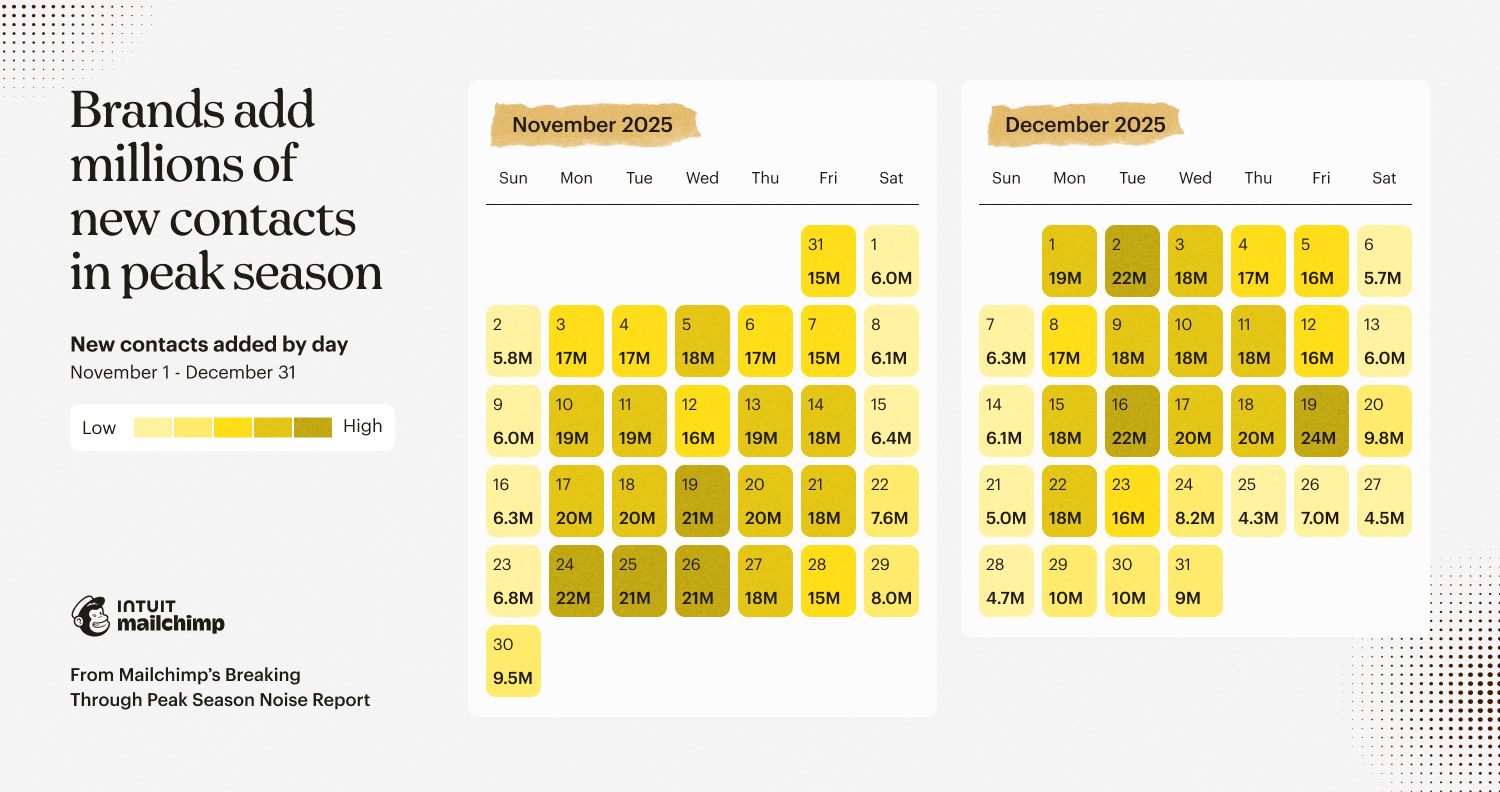
The 2025 holiday shopping period was defined by an aggressive expansion of customer databases. Throughout the golden quarter, brands utilizing the Mailchimp platform saw over 500 million new contacts added to their marketing audiences. This surge in data acquisition was not uniform; rather, it followed a distinct chronological pattern. Email contact acquisition peaked in the lead-up to the Black Friday Cyber Monday (BFCM) weekend, while SMS opt-ins experienced a sharp, vertical climb immediately preceding Black Friday.
This strategic accumulation of first-party data proved vital as retailers vied for visibility in an increasingly saturated digital marketplace. The data suggests that modern consumers are becoming more selective with their attention, forcing brands to leverage automation to ensure that their messages arrive at the precise moment of purchase intent.
Consumer Behavior and the BFCM Dynamic
The Black Friday Cyber Monday window remains the fulcrum upon which the entire retail quarter pivots. In the United Kingdom, the 2025 data indicates that first-time buyers were the primary drivers of growth during this period, accounting for 63% of all email-driven orders and nearly 62% of SMS-driven orders.
While acquiring new customers is often cited as the most expensive component of digital marketing, the 2025 data offers a more optimistic view of long-term retention. Among these first-time BFCM shoppers, 16.6% returned to make a second purchase within the first quarter of 2026. Notably, these returning customers demonstrated a high level of intent, with a median return window of just 26 days. This cycle underscores the importance of post-purchase automated sequences in converting one-time holiday shoppers into loyal, recurring clients.

The Quantitative Advantage of Personalization
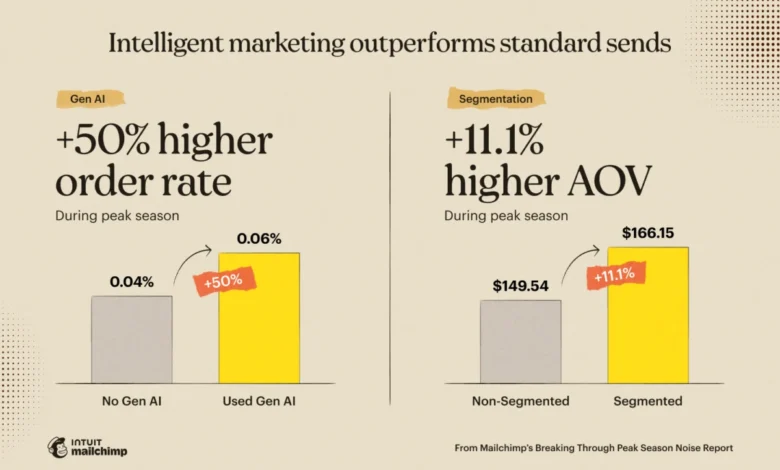
The report highlights a clear correlation between the level of message customization and financial performance. UK-based marketing campaigns that utilized dynamic content—tailoring product recommendations and messaging to the individual recipient—achieved a 10% higher average order value (AOV) compared to campaigns that utilized static, "one-size-fits-all" templates.
Furthermore, the integration of behavioral triggers, such as abandoned cart content blocks, proved to be a powerful tool for recovering lost revenue. Globally, these automated blocks generated a 36% increase in open rates and a 28% increase in click-through rates. By serving relevant, context-aware reminders, brands were able to re-engage shoppers who had demonstrated intent but required a nudge to finalize the transaction.
The Rise of Generative AI in Messaging
Perhaps the most significant shift observed in 2025 was the widespread adoption and efficacy of generative AI (Gen AI) in marketing communications. During the peak season, approximately 450 million emails were sent globally featuring AI-generated or AI-assisted content.
The impact of this technology on the bottom line was measurable and significant. In the UK, emails incorporating Gen AI features recorded a 9% higher order rate and a 5% higher conversion rate than their non-AI counterparts. This suggests that AI is no longer merely a tool for efficiency; it has become an instrument for quality improvement, enabling marketers to craft more persuasive, grammatically precise, and engaging copy at scale.
The Paradox of Weekend Engagement
An analysis of scheduling habits reveals a recurring inefficiency in retail marketing: the "weekday trap." The data indicates that weekends were the most effective days for driving sales, with order rates twice as high as those on weekdays. Despite this, brands consistently sent roughly 60% fewer messages on weekends.
This discrepancy highlights a missed opportunity for many retailers. The "shoulder days" surrounding the core BFCM event also saw unexpected strength in engagement. Interestingly, the Sunday between Black Friday and Cyber Monday emerged as a period of relative quiet, with 59% fewer emails and 82% fewer text messages sent compared to Black Friday. This suggests that consumers may be more receptive to marketing when the volume of promotional noise is significantly lower, offering a strategic window for brands looking to maximize their return on ad spend (ROAS).
Case Study: Gymwrap and the Unified Platform
The real-world application of these data points is best exemplified by fitness brand Gymwrap, founded by actor Nicole Ari Parker. Faced with the challenge of fragmented data, the brand consolidated its email and SMS marketing efforts under the Mailchimp umbrella prior to the peak season.
The result was a transformative improvement in campaign performance, with the company’s first full-scale SMS campaign delivering a 142x return on investment (ROI). Hume Merritt, Chief Marketing Officer at Gymwrap, noted that the consolidation of data was the primary catalyst for this success. "Having our email and SMS data in one place gives us a much clearer view of our customers," Merritt stated. "We can see how they prefer to engage with us and use that information to reach them in the right place."
Strategic Implications for Future Peak Seasons
The evidence gathered from the 2025 golden quarter points toward a fundamental evolution in retail marketing. The "noise" of the holiday season is no longer just a challenge of volume; it is a challenge of relevance.
- The Data Consolidation Imperative: As demonstrated by the success of unified platforms, siloed data is a hindrance to growth. Brands must prioritize integrated ecosystems that allow for a holistic view of the customer journey across all channels, including email, SMS, and web interactions.
- The Automation-AI Hybrid: The most successful campaigns of 2025 were those that paired human strategy with AI-driven execution. While AI can draft the copy and automate the trigger, the underlying strategy—knowing when to engage and how to segment the audience—remains a human-led requirement.
- Optimizing Timing Over Volume: The clear disparity between high weekend conversion rates and low weekend communication volume suggests that "less is more." Retailers moving into the next peak season would be well-advised to re-evaluate their delivery schedules, prioritizing high-intent days over daily volume-based campaigns.
- Retention as a Post-Peak Strategy: With a 16.6% retention rate among new BFCM shoppers, the golden quarter is not merely an acquisition event; it is a pipeline for the entire year. Developing post-peak loyalty workflows that nurture these new customers during the 26-day post-purchase window is essential for maximizing long-term customer lifetime value (CLV).
As the retail landscape continues to shift toward a model defined by precision, the integration of AI, automation, and unified data will remain the primary differentiator for brands. The 2025 peak season serves as a blueprint for this transition, demonstrating that those who embrace the intelligence within their data will not only cut through the noise but will establish more meaningful, profitable relationships with their customers in the process.
The industry expectation for the coming year is a further refinement of these tools, with generative AI likely to become standard practice rather than an experimental feature. As personalization becomes the baseline expectation of the modern consumer, the brands that can successfully marry the speed of AI with the intimacy of personalized communication will be the ones that define the market standard for years to come.